PHR Exam Content Outline 2026: 7 Domains, Not 5 | Certimeister
Verified against HRCI's published exam content outline and certification page on 14 August 2026.
Here is a test you can run in ninety seconds.
Open whatever you are studying from. Find the page listing the exam's functional areas. Count them.
If you count five, and Employee & Labor Relations is listed at 39% of the exam, you are studying for a version of the PHR that HRCI retired in 2024.
You are not behind. You are not underprepared. You are preparing precisely, diligently, and against the wrong document.
HRCI restructured the PHR in 2024. A large share of the prep material ranking on Google today still teaches the retired five-domain version, and the candidates using it have no way to tell, because no study guide announces its own expiry date.
This brief lays out the current outline, the retired one it replaced, what the gap costs in scored questions, and how to check your own materials before you lose another week to them.
The 7 PHR functional areas and their current weightings
HRCI's exam content outline, effective 2024, defines seven functional areas.
The exam itself runs 90 scored questions plus 25 unscored pretest items. Two hours of testing time plus 30 minutes of administration. Delivered at a Pearson VUE testing centre, or remotely through OnVUE.
The 5-domain PHR blueprint this replaced
The structure in force from 2018 until 2024 had five functional areas.

Two of the five survived untouched. One was cut nearly in half.
And two functional areas now carrying 27% of your exam between them were not broken out as areas at all. That content existed, scattered inside other domains. It had no weighting of its own, so no study plan built on the old map allocates a single hour to it as a domain.
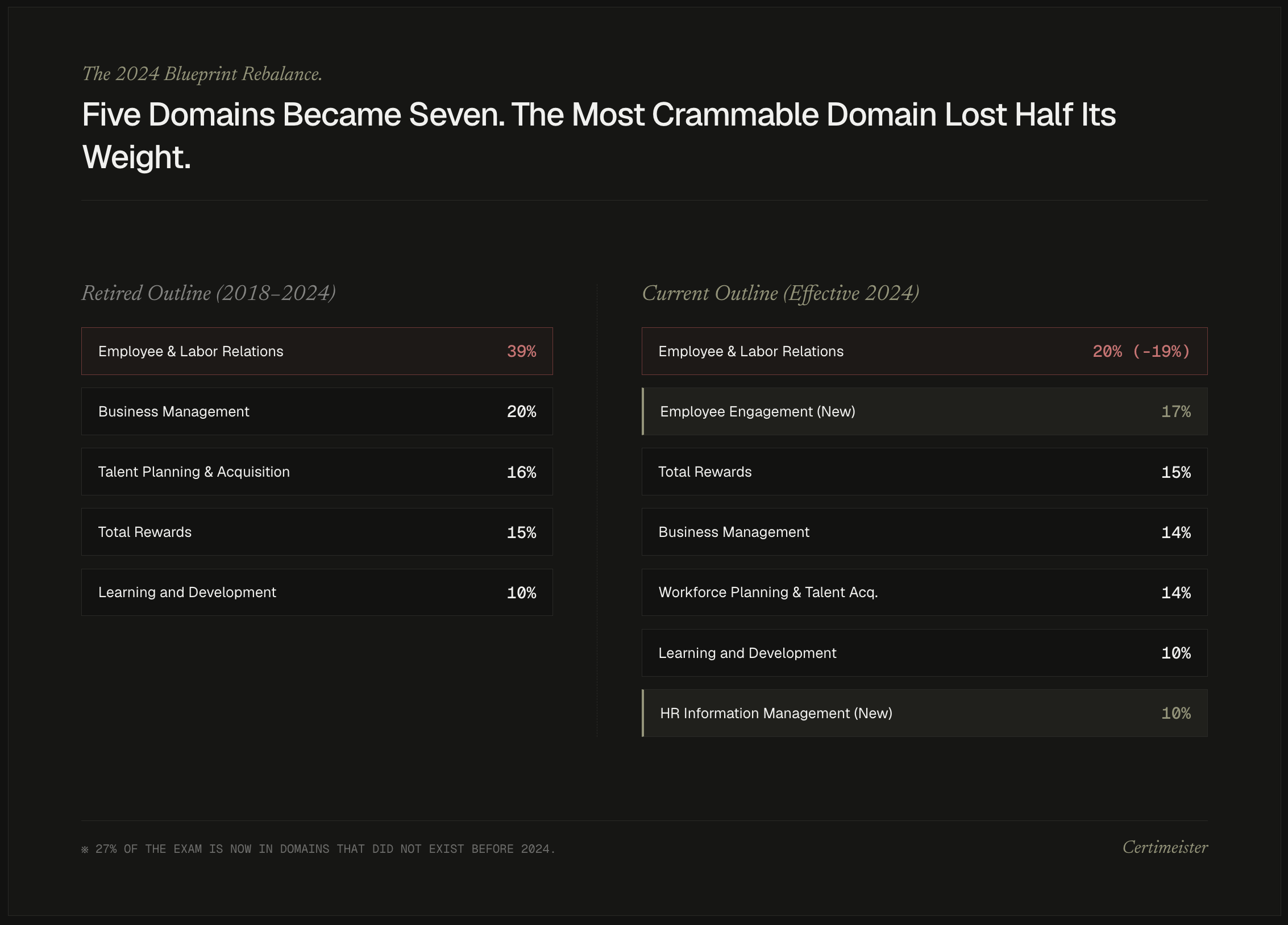
Work the arithmetic against 90 scored questions.
Employee Engagement is worth roughly 15 questions. HR Information Management is worth roughly 9. That is about 24 scored questions in territory the retired structure never asked you to budget for.
Meanwhile a candidate following the old weighting pours close to two fifths of their study time into Employee & Labor Relations. That domain is now worth one fifth of the exam.
Over study the statute heavy material. Under study nearly a quarter of the paper. Walk in confident.
The failure is undiagnosable from the inside. Every hour was spent well. Every chapter was read carefully. No study guide announces its own expiry date, and the candidate has no independent reason to question a document nobody told them to doubt.
The PHR exam format changed too: 90 questions, not 150
The domain weightings are not the only thing legacy sources get wrong.
The counterpoint a skeptical reader raises here: if the domains shifted, maybe the format details are just as unreliable as this brief's own claims. Check them the same way.
While auditing prep pages currently ranking for PHR queries, the same sources publishing the five area structure also publish:
"150 scored questions." HRCI's current published length is 90 scored plus 25 unscored pretest items.
"3 hours." HRCI publishes 2 hours of testing time, plus 30 minutes of administration.
"Prometric testing centers." HRCI delivers through Pearson VUE, or remotely through OnVUE.
Three verifiable facts about exam day, wrong on the same pages telling you what to study.
A candidate who paces a 150 question exam across three hours has built their entire timing strategy on a specification that no longer exists. Timing is the one thing you cannot repair once the clock starts.
We are not naming these sites. Check your own materials instead. That is the only audit that matters.
Key takeaways:
The PHR has seven functional areas, not five. The change took effect in 2024.
Employee & Labor Relations fell from 39% to 20%. If your material still says 39%, it is retired.
Employee Engagement (17%) and HR Information Management (10%) are the two areas that were not previously broken out. Together, that is 27% of the exam, roughly 24 scored questions.
The exam is 90 scored questions plus 25 pretest, 2 hours, at Pearson VUE or OnVUE.
The weight moved away from statute recall and toward judgment. That shift is the whole story.
HRCI puts the burden of being current on the candidate, not on the publisher.
WHY HRCI SHIFTED THE WEIGHT TOWARD JUDGMENT
The obvious reading is administrative housekeeping. It is not.
Look at which areas gained.
Employee Engagement, at 17%, is now the second largest domain on the exam. It is also the least memorizable material on the blueprint. Performance management. Corrective action. Performance improvement plans. Involuntary separations. Reductions in force. Offboarding.
Almost no black letter law to commit to a flashcard. Only judgment.
HR Information Management, at 10%, covers data integrity, reporting, system access and permissions, and security practices. Work that in a real HR department gets escalated to IT, and on the exam belongs to you.
And the domain that shrank by nineteen points is the one densest with statute, citation and definition. The most crammable content on the exam lost the most ground.
The blueprint did not simply get rearranged. It got harder to cram for and easier to fail on instinct. The exam moved toward exactly the questions where an experienced HR professional's workplace reflex is most confident and most wrong.
This is what the test makers built. They published the evidence themselves, and almost nobody read past the percentages.
The counterpoint most candidates reach for: treat this as a scheduling problem, move some hours from labor relations into engagement, and carry on. That misses what the numbers are saying. The exam deliberately reduced the material you can memorize and increased the material you have to judge. On the domains that grew, there is often no rule to recall. There is a scenario, four defensible answers, and one that is most correct. Studying harder does not help you there. Studying harder is what got you the wrong answer with confidence.
HRCI prints this inside the outline document:
"We realize that employment laws change constantly. Candidates are responsible for knowing the HR laws and regulations that are in effect at the time of their exam."
Read it again. The obligation to be current sits with you, not with the resource you paid for. Your study guide carries no duty to be right, and no duty to tell you when it stopped being right. A book printed in 2022 will teach a retired standard with total, unbroken confidence.
Before you sit another mock exam, make sure your next PHR practice test is built on the seven-area outline.
HOW TO AUDIT YOUR PHR STUDY MATERIALS IN 90 SECONDS
Count the functional areas. Five means retired. Seven means current.
Check Employee & Labor Relations. 39% means retired. 20% means current.
Search for "Employee Engagement" and "HR Information Management." If neither appears as its own functional area, you have no study plan for 27% of the exam.
Check the stated question count and exam length. 150 questions or 3 hours means the source is not maintained.
If your materials fail any of these, the problem is not that one fact is wrong. It is that you now have no way of knowing what else is.
Once your materials pass the audit, take a PHR practice test written against the 2024 outline.
Where Certimeister sits
Certimeister is built on the current seven area outline. Every test runs 115 questions, matching HRCI's current format of 90 scored plus 25 pretest items. That is table stakes and we will not pretend otherwise. Being accurate is the minimum. It is not what separates us.
What separates us is what happens after you answer.
Certimeister is not a question bank that marks you right or wrong. Tutor Mode ends every question with Instructor's Notes that show you how the question was engineered. Which answer was built to look correct to someone who does this work for a living, and precisely why your experience reached for it.
On a blueprint that just moved 27% of its weight toward pure judgment, knowing the correct answer is worth far less than knowing why the wrong one felt right.
Try 25 free PHR questions in Tutor Mode. See the logic behind every wrong answer.
If you go on to use the full simulator and do not pass your PHR exam, email letstalk@certimeister.org. Full refund. No questions asked.
FREQUENTLY ASKED QUESTIONS
How many functional areas are on the PHR exam?
Seven. Business Management (14%), Workforce Planning and Talent Acquisition (14%), Learning and Development (10%), Total Rewards (15%), Employee Engagement (17%), Employee and Labor Relations (20%), and HR Information Management (10%). This structure took effect in 2024 and replaced a five-area outline.
What are the current PHR exam weightings?
Employee and Labor Relations is the largest at 20%, followed by Employee Engagement at 17%, Total Rewards at 15%, Business Management at 14%, Workforce Planning and Talent Acquisition at 14%, and Learning and Development and HR Information Management at 10% each.
How many questions are on the PHR exam?
90 scored questions plus 25 unscored pretest items, for 115 total. Testing time is 2 hours, plus 30 minutes of administration.
Is Employee and Labor Relations still 39% of the PHR?
No. That was the weighting under the blueprint in force from 2018 until 2024. It is now 20%. Any resource still showing 39% is built on the retired outline.
How do I know if my PHR study guide is out of date?
Count the functional areas. Five means retired, seven means current. Then check whether Employee Engagement and HR Information Management appear as their own areas. If they do not, the material predates the 2024 outline.