Employee Engagement: 17% of the PHR, Not Filler.
The domain rewards process consistency, not workplace judgment. Documentation applied the same way for everyone beats a defensible-sounding individual decision.

Verified against HRCI's PHR Exam Content Outline, effective 2024, on 12 August 2026.
HRCI's Employee Engagement domain has four parts. Three of them are exactly what the name promises: measuring the employee lifecycle, running engagement programs, supporting performance strategy. The fourth, worth a quarter of the domain on its own, is performance improvement plans, corrective action, involuntary separation, reductions in force, and offboarding. That is not engagement. That is the highest-stakes work an HR Coordinator does. It is sitting inside the one domain candidates have already decided not to worry about.
When HRCI restructured the PHR in 2024, Employee Engagement became a standalone functional area for the first time. Before the change, this content did not have its own weight or its own line on the blueprint. It existed, scattered, folded into whatever domain seemed closest.
Two years later, the name has not caught up to the content. "Engagement" tests as soft. Section 5.4 does not. A candidate who reads the domain title and budgets it like the light lift it sounds like walks directly into the one part of the exam where a confident, lived-experience answer is most likely to be wrong.
What is actually inside the Employee Engagement domain
"Developing, communicating, and enhancing employee engagement initiatives to support optimal employee performance management activities throughout the employee lifecycle."
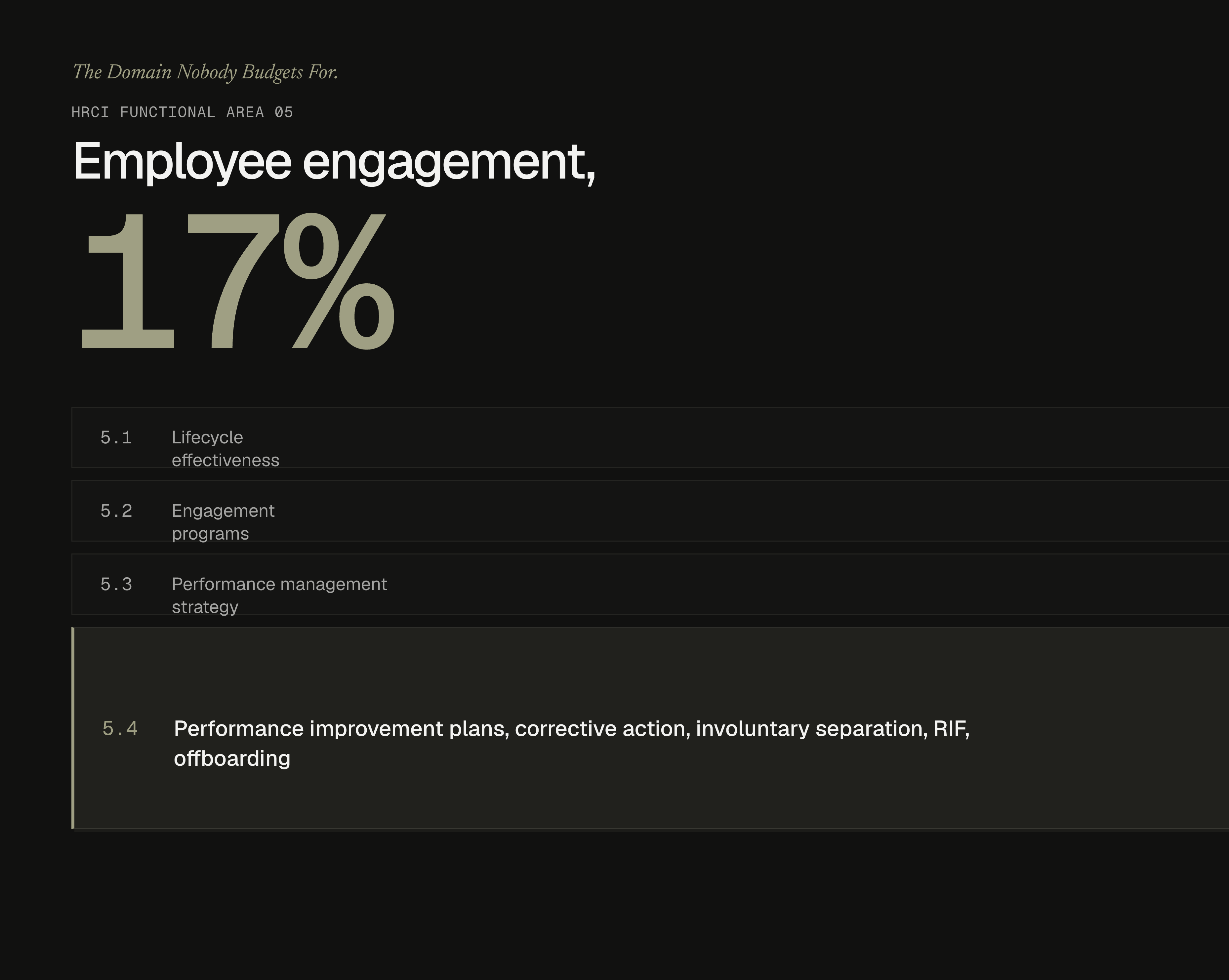
Three sections of employee experience work. One section is terminations, discipline, and layoffs. All four sit under a domain name that promises none of the fourth.
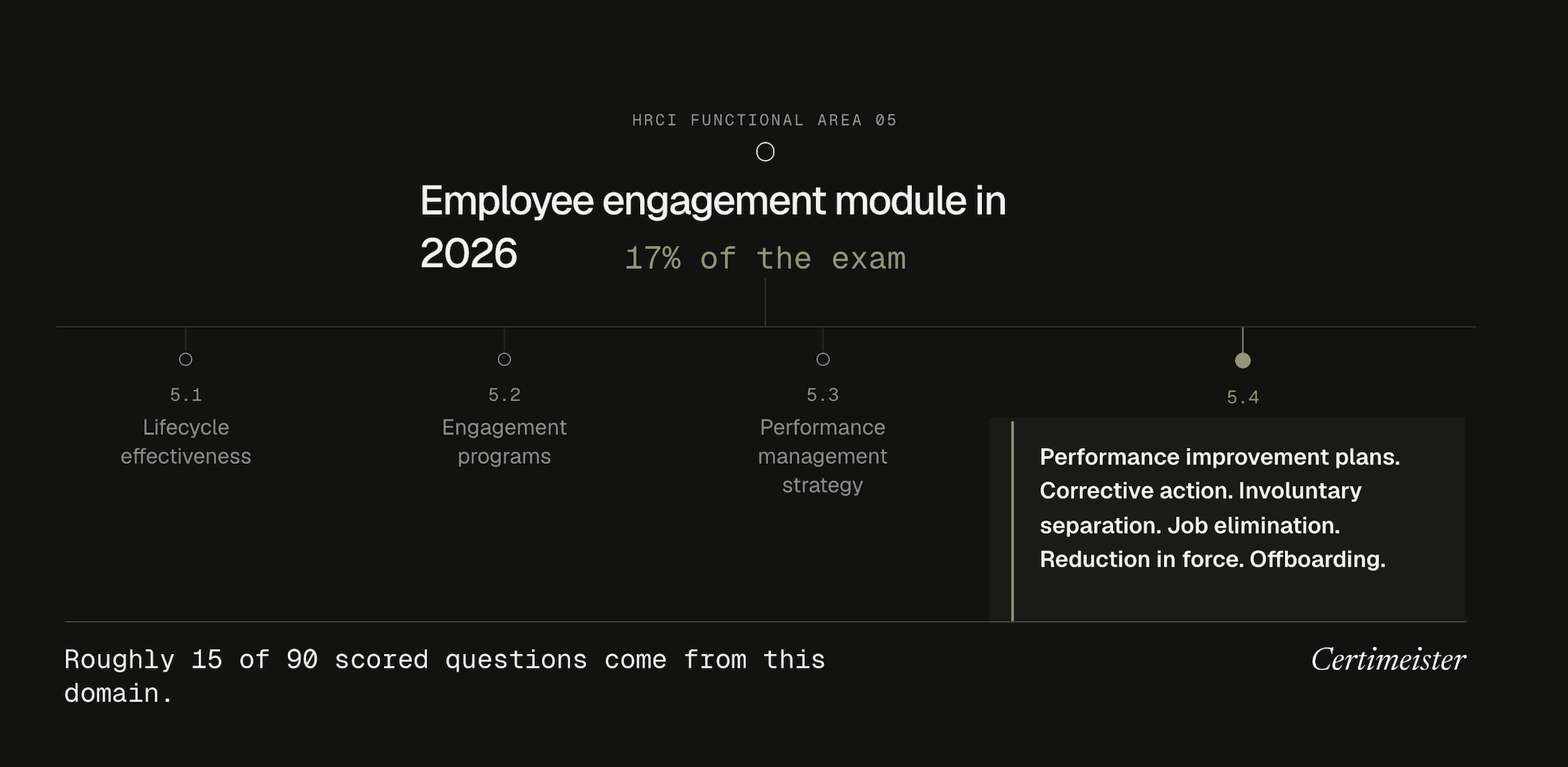
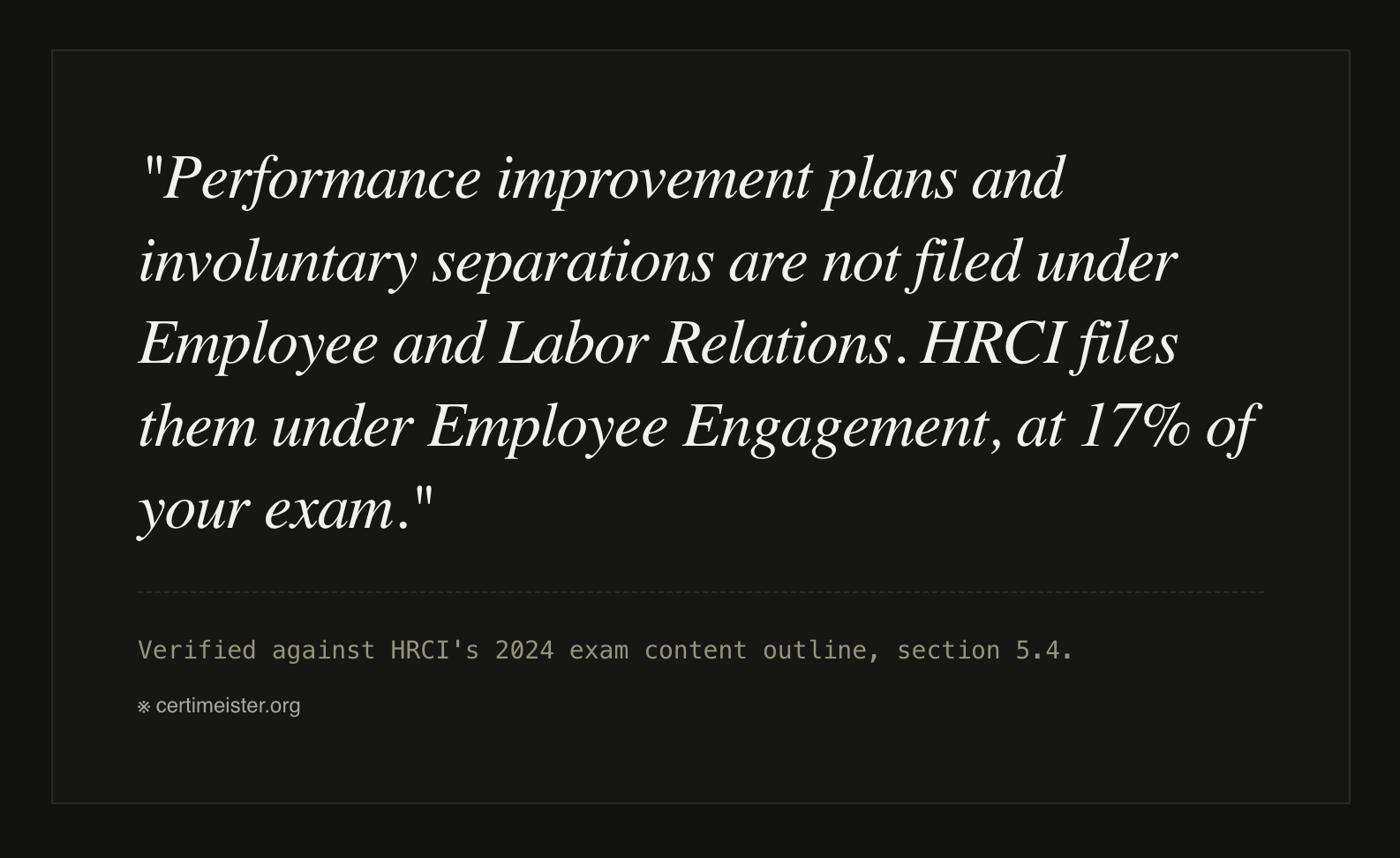
The counterpoint a skeptical reader raises here: performance improvement plans and terminations sound like they belong in Employee and Labour Relations, the domain that already covers workplace conflict and compliance. Reasonable instinct. Check the outline instead of the instinct: HRCI places 5.4 inside Employee Engagement, not Employee and Labour Relations. The exam's own architecture disagrees with where a working HR professional would file this content, and the exam's architecture is the one that counts on exam day.
Why the exam buries its hardest content in its softest sounding domain
Run the arithmetic against 90 scored questions. Employee Engagement is worth roughly 15 questions. If 5.4 is a full quarter of the domain, that puts somewhere close to 3 to 4 scored questions sitting inside a section most candidates never separately budgeted for, because they were budgeting for "engagement," not "involuntary separation."
Three or four questions sounds survivable in isolation. It stops sounding survivable once you notice the pattern repeats. Spike 1 already showed that Employee Engagement and HR Information Management together account for 27% of the exam and were never broken out as separate domains before 2024. Section 5.4 is a second layer of the same problem, one level deeper: even within a domain candidates now know exists, the hardest content is still hiding inside the part with the gentlest name.
What legacy materials get wrong about this domain
While checking how currently ranking PHR prep content handles Employee Engagement, the pattern was worse than simple staleness. Three distinct failure types showed up, each on live, indexed pages:
The domain does not exist at all. One widely used prep resource's own published exam breakdown lists six functional areas, with no Employee Engagement anywhere, a domain structure that predates even the five-domain outline retired in 2024.
The domain is folded into the wrong place. A second active page, updated within the last two weeks, still teaches the retired five-domain blueprint and files "employee engagement and retention strategies" as a bullet point inside Employee and Labour Relations, not as its own domain.
The domain exists, but the hard part is missing. A third resource, current and correctly named, describes Employee Engagement as culture, surveys, and performance support. No mention of performance improvement plans, corrective action, involuntary separation, reductions in force, or offboarding anywhere in the description.
We are not naming these sites. Check your own materials the same way: does your resource's Employee Engagement section mention terminations, RIF, or offboarding by name. If it does not, you have a study guide that knows the domain exists and still will not tell you what is actually in it.
Why the soft name is the trap
Call this what it is. A domain named "Employee Engagement" reads as culture work. Culture work is where an experienced HR professional feels most confident, because it is the part of the job that runs on relationships and instinct rather than statute.
That confidence is exactly what makes 5.4 dangerous. It sits inside the one domain a candidate has already decided is low risk, using the skill a candidate trusts most: their own judgment about what is fair. And the exam is not testing fairness. It is testing whether the process was documented and applied consistently, whether the sequence of coaching, corrective action, and separation followed the organization's own standard, and whether that standard was applied the same way regardless of who the employee was.
The counterpoint most candidates reach for here: "I've run PIPs. I know how this works." That is precisely the trap restated. Lived experience running a PIP at one company teaches how that company does it, not what the exam is scoring. The exam is not asking whether the PIP was reasonable. It is asking whether it was consistent, and consistency is invisible from inside a single case, because a candidate who has only ever run PIPs at their own employer has no comparison point for what "consistent" even means.
Four illustrative examples of the shape this takes:
The PIP that improved, then relapsed. A manager wants to terminate immediately after a second dip, without a second documented review period. The workplace instinct says the manager has already given enough chances. The tested instinct asks whether the same standard, same review cadence, would apply if a different employee had the identical performance pattern.
The RIF that targets the newest hires. Cutting the most recent hires first feels neutral and cost-driven. The tested question is whether that selection method creates a disparate impact on a protected class, because recency of hire and demographic composition are not independent variables in most real workforces.
The policy violation nobody enforced last time. An employee is terminated for a handbook violation that a different employee committed six months earlier and kept their job over. The workplace read is "this case is worse." The tested read is that inconsistent enforcement is the liability, regardless of which individual case looks more severe.
The offboarding that skips a step because the employee is well liked. A manager wants to fast-track an exit interview and skip standard documentation because the departure is amicable. The tested principle is that offboarding process does not flex based on how the separation feels.
Every one of these reads as a people question. Every one of them is actually a documentation and consistency question wearing a people question's clothes. That is the entire domain in miniature.
How to audit your PHR study materials for this domain
Find the Employee Engagement section in whatever you are using. If it does not exist as its own named section, your materials predate 2024.
Check whether it mentions performance improvement plans, corrective action, or involuntary separation by name. If it only talks about surveys, culture, and wellness, you have half the domain.
Ask whether any practice questions in this domain are about terminations, RIF, or offboarding. If every practice question in "Employee Engagement" is about morale or recognition, your practice bank does not match the real domain.
Time yourself, honestly, on how many hours you have budgeted for this domain versus Total Rewards or Business Management. If Engagement is getting less time because it feels less technical, that is the trap operating on you directly.
If your materials fail step two, the fix is not reading more slowly. The fix is different materials.
Where Certimeister sits
Certimeister is built on the current seven area outline. Every test runs 115 questions, matching HRCI's current format of 90 scored plus 25 pretest items. That is table stakes. Being accurate is the minimum, not the moat.
The moat is what happens after you answer. Certimeister does not stop at right or wrong. Tutor Mode ends every question with Instructor's Notes that explain why the wrong answer felt right to someone who has actually run a PIP or handled a termination, and what the exam is really scoring instead. On a domain where the trap is your own confidence, knowing the correct answer matters less than knowing why your first instinct reached for the wrong one.
"I didn't have an instructor explaining it to me. The practice testing and explanations really helped. I passed!"
- Michele T., PHR Certified
Michele passed without a live instructor. The explanations did the work a tutor usually does. That is the entire premise of this domain: there is no rule to memorize in section 5.4, only a reasoning pattern someone has to teach you, and Tutor Mode is built to teach exactly that.
Take the 5-question demo: no email, no account, no credit card. Five questions from the domain candidates study last, with the reasoning pattern shown after every answer.
If you go on to use the full simulator and do not pass your PHR exam, email letstalk@certimeister.org. Full refund. No questions asked.
FREQUENTLY ASKED QUESTIONS:
What percentage of the PHR exam is Employee Engagement?
17%. It is the second largest of the seven functional areas, behind Employee and Labour Relations at 20%. That works out to roughly 15 of the 90 scored questions.
What topics are covered in the PHR Employee Engagement domain?
Four areas under HRCI Functional Area 05: measuring effectiveness across the employee lifecycle, supporting engagement programs like surveys and wellness activities, supporting performance management strategy, and supporting performance and employment activities including performance improvement plans, corrective actions, involuntary separations, job eliminations, reductions in force, and offboarding.
Is Employee Engagement a hard domain on the PHR exam?
It is harder than its name suggests. Most of the domain rewards straightforward judgment about culture and performance support. One section, 5.4, covers terminations and involuntary separations, and tests process consistency rather than workplace instinct, which is where experienced candidates tend to lose points.
When did Employee Engagement become its own domain on the PHR exam?
2024, when HRCI restructured the exam from five functional areas to seven. Before that, this content had no standalone weighting and was distributed inside other domains.
Does performance improvement plan content count toward Employee Engagement or Employee and Labour Relations?
Employee Engagement, specifically HRCI section 5.4. This surprises many candidates, who expect termination and discipline content to sit under Employee and Labour Relations instead.