PHR Essay # 10: How to Calculate Overtime With a Non-discretionary Bonus
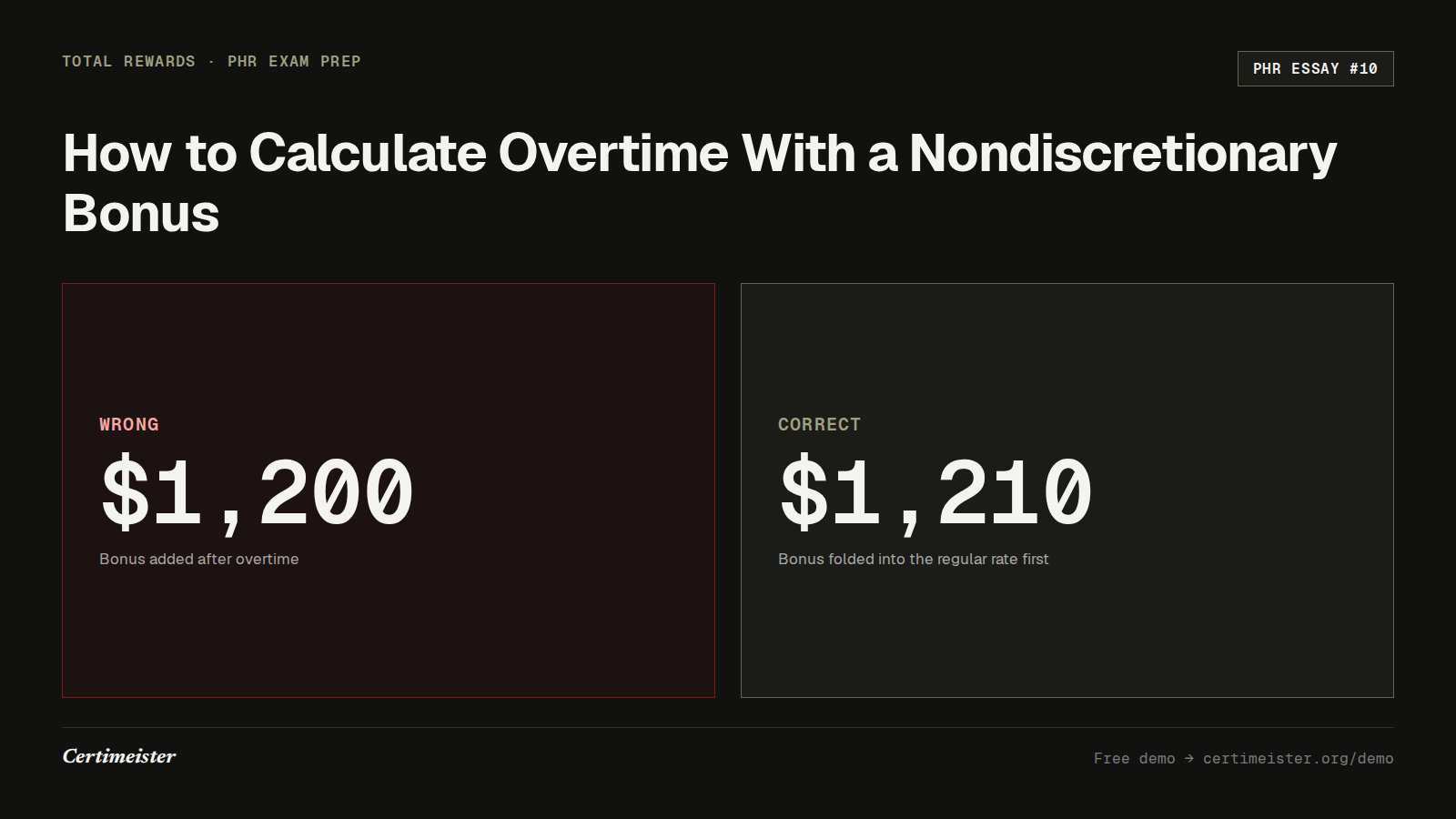
How to Calculate Overtime With a Nondiscretionary Bonus
Category: Calculations
A nondiscretionary bonus can change overtime pay. Under the FLSA, you usually put this bonus into the regular rate first. Then you calculate overtime.
Two words, one plain meaning each:
Regular rate: total straight-time pay for the week (including bonuses that must count), divided by hours worked.
Nondiscretionary bonus: promised in advance, or tied to a formula or goal. A production bonus usually counts.
Example: $20 an hour, 50 hours, $100 bonus
Facts:
$20 an hour
50 hours in the week
$100 promised production bonus
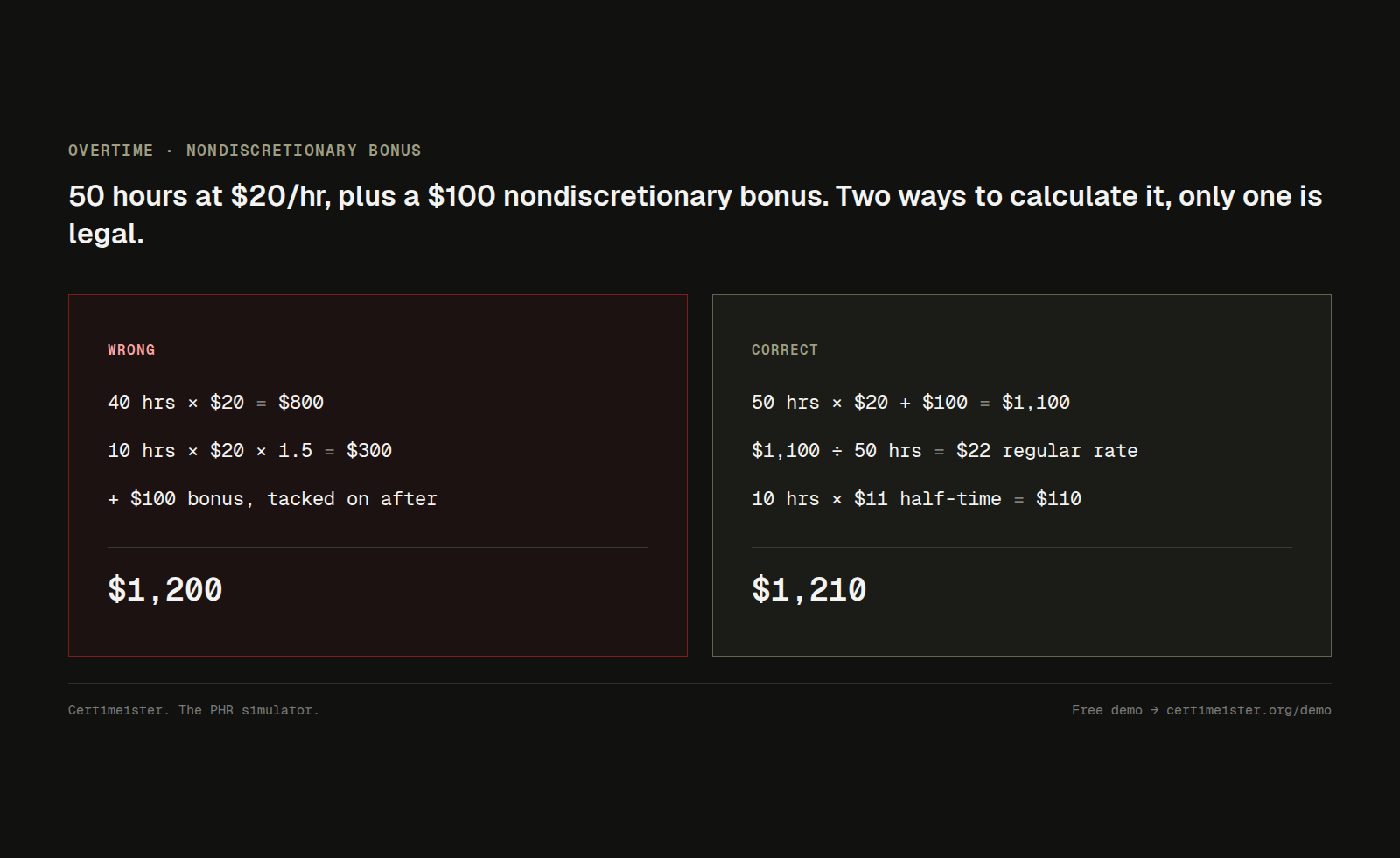
Wrong path → $1,200
40 × $20 = $800
10 overtime hours × $30 = $300
Add $100 bonus after
Total = $1,200
Right path → $1,210
50 × $20 = $1,000
Add $100 bonus → $1,100
$1,100 ÷ 50 = $22 regular rate
Extra half of $22 = $11
10 overtime hours × $11 = $110
$1,100 + $110 = $1,210
Remember: $1,100 already paid every hour once. Overtime only adds the extra half for hours past 40.
When the bonus stays out
Only if it is truly discretionary: employer decides both the fact and the amount late, with no earlier promise. Labeling it "bonus" is not enough.
Federal FLSA only. State rules may differ.
The PHR exam distinction
Start with classification. If the bonus was promised or tied to a result, fold it into the regular rate before overtime math. The habit answer ($1,200) skips that rebuild.
Where Certimeister sits
Certimeister is a PHR simulator built for the current exam outline. Being accurate is the minimum.
The moat is what happens after you answer. Tutor Mode does not stop at right or wrong. Instructor's Notes explain why the tempting answer felt right, and what the exam is really scoring instead. On overtime-with-bonus items, that means naming the habit ($1,200) and walking you to the scored path ($1,210).
Try the free 5-question demo. No email, no account, no credit card. See how Tutor Mode dismantles the trap after each question.
Sources
DOL Fact Sheet 56C: https://www.dol.gov/agencies/whd/fact-sheets/56c-bonuses
29 CFR 778.211: https://www.law.cornell.edu/cfr/text/29/778.211