RBAC, SSO, MFA: The PHR Trap That Repeats Five Times
Your safe answer is the trap
Ask an HR professional what encryption does and most will say it protects data. That instinct is useful at work. On the PHR exam, it is often the decoy.
Functional Area 07, HR Information Management, is about 10% of the exam. The same cluster of terms keeps returning: RBAC, SSO, MFA (or 2FA), encryption at rest, encryption in transit, and data masking. Each term solves a different threat. The exam does not mainly test definitions. It tests whether you can match the term to the threat described in the stem.
Why experience makes this worse
If you have sat through a vendor security review, you already have an instinct here. Someone says encryption and the room relaxes. It sounds like the safe, general answer. That is exactly the gap item writers exploit.
The primary pattern in Full Test 1 is a job-function access problem, not a device-theft encryption story. Encryption language appears as a distractor while the correct architecture is Role-Based Access Control.
Primary scenario: restrict HRIS access by job function
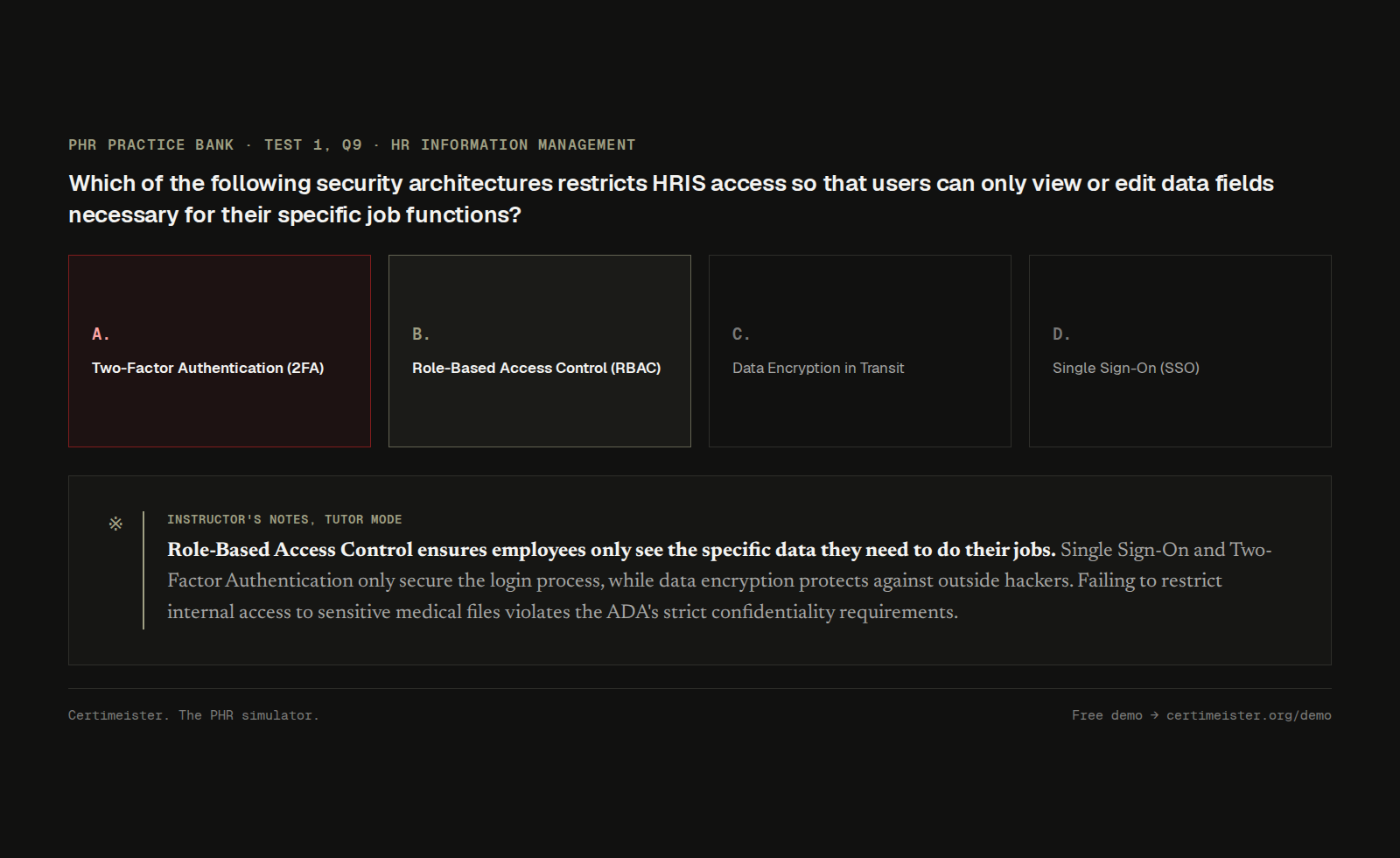
Here is the stem as it appears in Tutor Mode (Full Test 1, Q9):
Which of the following security architectures restricts HRIS access so that users can only view or edit data fields necessary for their specific job functions?
A) Two-Factor Authentication (2FA)
- B) Role-Based Access Control (RBAC)
- C) Data Encryption in Transit
- D) Single Sign-On (SSO)
The correct answer is B, RBAC. Role-Based Access Control limits what each user can see or edit to what their job requires.
2FA and SSO secure the login path. Encryption in transit protects data while it moves across a network. None of those three answers the stem's actual ask: restricting field-level access by job function. Candidates who default to "security means encryption" often land on C and miss the point.
Failing to restrict internal access to sensitive medical files can also create ADA confidentiality exposure. The exam item is still testing the architecture match: RBAC for least-privilege access inside the HRIS.
Threat-matching drill: encryption in transit vs at rest
A different stem asks a different question. Do not recycle the RBAC answer when the threat is interception in motion.
Here is Full Test 7, Q114:
Which security measure is specifically designed to protect employee data from interception while it moves across a network between an HRIS and a third-party payroll provider?
A) Encryption at rest
- B) Encryption in transit
- C) Data masking
- D) Multi-factor authentication
The correct answer is B, encryption in transit. Data is most vulnerable to interception while it is moving. Encryption at rest only protects data sitting idle on a server. Data masking hides sensitive fields on a screen. MFA hardens login. None of those three answers the interception-in-motion threat.
Notice the trap inversion from Q9. In the RBAC item, encryption in transit is the distractor. In this item, encryption at rest is the distractor. Same vocabulary cluster. Different threat. Different correct term.
Optional SSO check: password fatigue across HR apps
When the stem is about reducing password fatigue across multiple HR SaaS applications, the match shifts again.
Here is Full Test 7, Q19:
Which technology should HR and IT implement to strategically enhance security and reduce 'password fatigue' across multiple HR SaaS applications?
A) Implementing Multi-Factor Authentication (MFA) independently on each individual application.
- B) Implementing Federated Identity Management (SSO) integrated with the core HRIS.
- C) Deploying a decentralized password vault managed locally on each employee's device.
- D) Consolidating all applications into a single ERP platform to eliminate third-party logins.
The correct answer is B. SSO lets employees authenticate once and reach connected HR apps. MFA on every app separately can worsen fatigue. A decentralized password vault creates new IT risk. Consolidating everything into one ERP is not the targeted fix for login sprawl.
SSO answers "how many times do people prove who they are across systems." RBAC answers "what can they see once they are in." Encryption answers "can the data be read if someone intercepts or steals it." Match the threat before you pick the acronym.
The six terms, six different jobs
RBAC controls who can see or change what, based on their role.
- SSO controls how many times someone has to prove who they are across systems.
- MFA / 2FA controls whether one stolen password is enough to get in.
- Encryption at rest protects data sitting in a database or on a drive.
- Encryption in transit protects data moving between systems.
- Data masking hides real values from people who do not need to see them, without deleting the data.
Six different jobs. One common instinct: security means encryption. The exam exploits that gap on purpose.
What Tutor Mode shows that an answer key does not
A generic key explains why the wrong letter was wrong. It does not train the habit you need under time pressure: name the threat first, then pick the term that solves that threat.
On the PHR simulator, Tutor Mode walks the mismatch out loud. In Q9, it shows why encryption in transit felt safe and why RBAC was the architecture the stem actually described. In Q114, it shows why encryption at rest is the near-miss when the data is moving to a payroll vendor.
Try it on a real scenario
Try the free 5-question demo. No email, no account, no credit card. Practice matching the threat before you reach for the safest-sounding term.