Kirkpatrick's Four Levels: The PHR Exam's L&D Trap
The trap hiding in plain sight
A corporate negotiation skills training program ends. Some participants leave happy. Some score higher on a knowledge test. Some start using the new tactics in vendor meetings. And in the quarter after the workshop, overall supply chain costs drop.
Four outcomes. One of them is Kirkpatrick Level 4. The PHR exam is not asking whether you can list Reaction, Learning, Behavior, and Results. It is asking whether you can tell which metric already crossed into Results when Behavior language is sitting in the same item.
This is Functional Area 03, Learning and Development. It is about 10% of the exam. Legacy study guides often treat it as a naming drill. The bank treats it as a classification problem.
Why Behavior is the bait
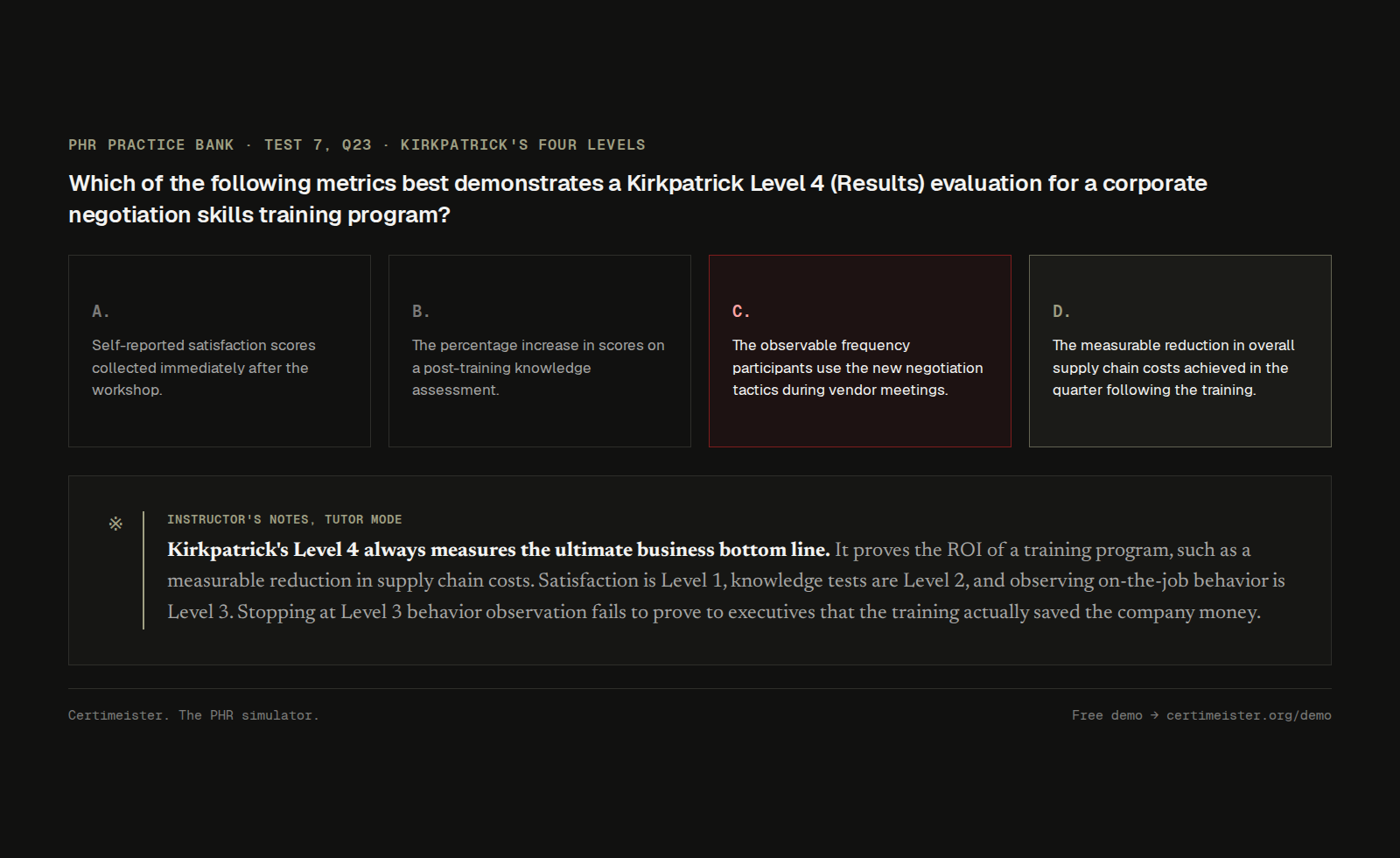
Here is the stem as it appears in Tutor Mode (Full Test 7, Q23):
Which of the following metrics best demonstrates a Kirkpatrick Level 4 (Results) evaluation for a corporate negotiation skills training program?
A) The participants' self-reported satisfaction scores collected immediately after the workshop.
B) The percentage increase in the participants' scores on a post-training knowledge assessment.
C) The observable frequency with which participants utilize the new negotiation tactics during vendor meetings.
D) The measurable reduction in overall supply chain costs achieved in the quarter following the training.
Option C is Level 3. It is also the most vivid, human detail on the page. Observable use of new tactics during vendor meetings feels like proof the training worked. Many candidates stop there.
Option D is Level 4. A measurable reduction in overall supply chain costs is not a prediction of business impact. It is the business result, already counted. That is the correct answer.
Read past the behavior to the number
The failure pattern is stopping at the first classifiable detail instead of reading the whole stem.
Satisfaction scores after the workshop are Level 1 (Reaction).
Higher scores on a knowledge assessment are Level 2 (Learning).
Observable on-the-job use of the tactics is Level 3 (Behavior).
A measured business outcome such as lower supply chain costs is Level 4 (Results).
When Behavior language and a business number appear together, the measured number means the scenario has already crossed into Level 4. Behavior is a precondition for Results. It is not a substitute for Results.
The four levels, and what each one measures
Level 1, Reaction: whether participants liked the training.
Level 2, Learning: whether participants can demonstrate the knowledge or skill.
Level 3, Behavior: whether participants apply that skill on the job.
Level 4, Results: whether applying that skill changed a business metric.
Levels 3 and 4 are the pair the exam confuses most often, because Level 3 is a precondition for Level 4 and the two frequently appear in the same item.
What Tutor Mode shows that a generic answer key does not
A standard key says the answer is D. It does not tell you why C felt complete on its own. Tutor Mode flags the Behavior bait (observable use of negotiation tactics) and points you to the Level 4 evidence you had to read past it to reach: the measurable reduction in overall supply chain costs.
Practice the Level 3 / Level 4 split
Try the free 5-question demo. No email, no account, no credit card. See how the bait is planted in the stem, and how to read past it on the PHR simulator.